For busy photographers and scaling agencies, selecting a clipping path provider is less about outsourcing and more about reclaiming billable hours and streamlining the post-production pipeline.
Around 45% of e-commerce stores, photography studios, and marketing agencies use photo clipping path workflows to save time during image preparation. Nearly 40% reduce costs by reusing consistent clipping path images instead of creating new photos for visual changes.
A clipping path service is a professional photo editing solution where expert editors use vector paths to surgically isolate a subject from its background. With hundreds of offshore options available, identifying a provider that understands the nuances of complex edges and tight deadlines is essential for long-term success. Having a partner with a good photo editing service company will benefit you with hassle-free turnaround, good quality editing, image security, and deliverability.
To help you navigate the crowded marketplace, we have identified the sixteen non-negotiable standards every professional agency should demand from its clipping path provider.
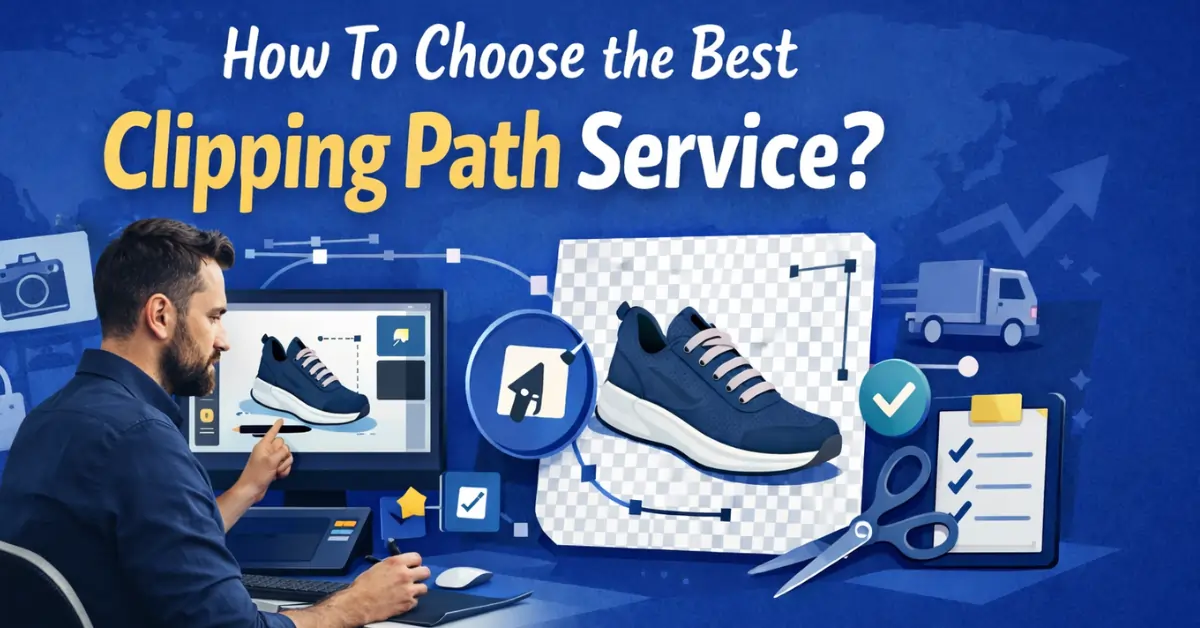
How to Choose the Best Clipping Path Service Provider
Clipping Path is an image editing technique that use photoshop pen tool to draw a vector path around an object in an image. This is one of the most common post-production image editing techniques used by product photographers and graphic designers.
When choosing the right clipping path service company, evaluate their editing quality through a free trial. Then you need to verify their daily editing capacity, communication, support, and transparent, complexity-based pricing.
A free trial or sample lets you review real quality, speed, and communication style, help decide confidently before signing contracts or committing budgets for long-term service relationships.
Once you have listed or came contract with a service provider, you need to opt for a free trial. Here is what to check in this step-
Here are the steps you need to follow.
1. Quality of Editing
The quality of editing shows whether edges are clean, shapes are accurate, details remain intact, and images meet professional standards. Manual or hand-drawn clipping service paths are created by skilled professionals, ensuring accuracy for complex shapes, fine edges, and detailed photos that automated tools often fail to handle properly.
2. Color and Image Quality Integrity
Color integrity means original colors stay unchanged after editing, so products appear realistic, trustworthy, and transparent. On the other hand, you need the original image to be preserved.
Helping businesses avoid customer confusion, brand damage, and product returns on online platforms.
3. Affordable Pricing
You should look for a service that offers a transparent, tiered pricing model, ensuring you only pay for the specific complexity of your images.
Affordability is the key, not how cheap it is. If you choose the cheapest option but have to spend your own time fixing mistakes, you haven’t actually saved any money. A clipping path, in general, is a cost-effective service. So, you should look for a partner that offers a transparent credit system.
4. Time Effectiveness & Bulk Editing
You aren’t just paying for edited photos. You are paying for the peace of mind that comes with a streamlined workflow that never misses a beat. You need a flexible partner who can scale their output up or down based on your seasonal demands, ensuring you never miss a product launch deadline.
Handling bulk work assesses the ability to process a large number of images on schedule, maintain consistent quality, and prevent delays when product volumes increase during busy sales campaigns. Hence, you should prefer a company that also provides image cutout or background removal, image masking, and image retouching services to meet all your editing needs.
5. Customer Support
Customer support shows how quickly issues are answered and resolved, ensuring smooth coordination, reduced downtime, and continued progress when questions, changes, or urgent issues arise during production.
Time-zone and workflow compatibility ensure smooth collaboration by allowing feedback, revisions, and approvals to happen without long waiting periods, missed messages, or production slowdowns caused by poor scheduling alignment issues.
6. Communication with Editors
When you work with a top-tier provider, you should expect a transparent communication loop.
As a photographer I know how boring it can be to provide detailed instructions for every project. I prefer to provide shot instructions or a voice message. Besides, communication helps ensure healthy delivery timelines and status updates, so you always know the exact state of your project.
7. Revision Policy
Revision policy explains how corrections are requested, handled, and delivered, including limits and response times, so clients know mistakes will be fixed efficiently without any extra cost. You should prioritize a service that treats revisions with the same urgency as the initial order.
8. Contract & Long-Term Reliability
A contract clearly defines services, revision limits, pricing terms, data ownership, and responsibilities, ensuring both parties understand expectations before work begins and reducing disputes during long-term collaboration agreements.
Long-term reliability shows whether consistent quality, delivery speed, and support are maintained over time, helping businesses build dependable partnerships instead of facing performance drops after initial projects years later.
9. File Sharing & Compatibility
File sharing should use secure systems with organized folders and clear naming, making files easy to access, track, and retrieve during revisions, deliveries, audits, and future reference needs safely and consistently.
File compatibility ensures delivered images meet required formats, resolutions, layers, and backgrounds, preventing technical problems during uploads, printing, or design placement across different platforms.
10. Data Security & NDA
Data security and NDA practices protect confidential images and business information, ensuring files are not shared, reused, or accessed without permission, helping companies safeguard ownership and reduce legal risk exposure.
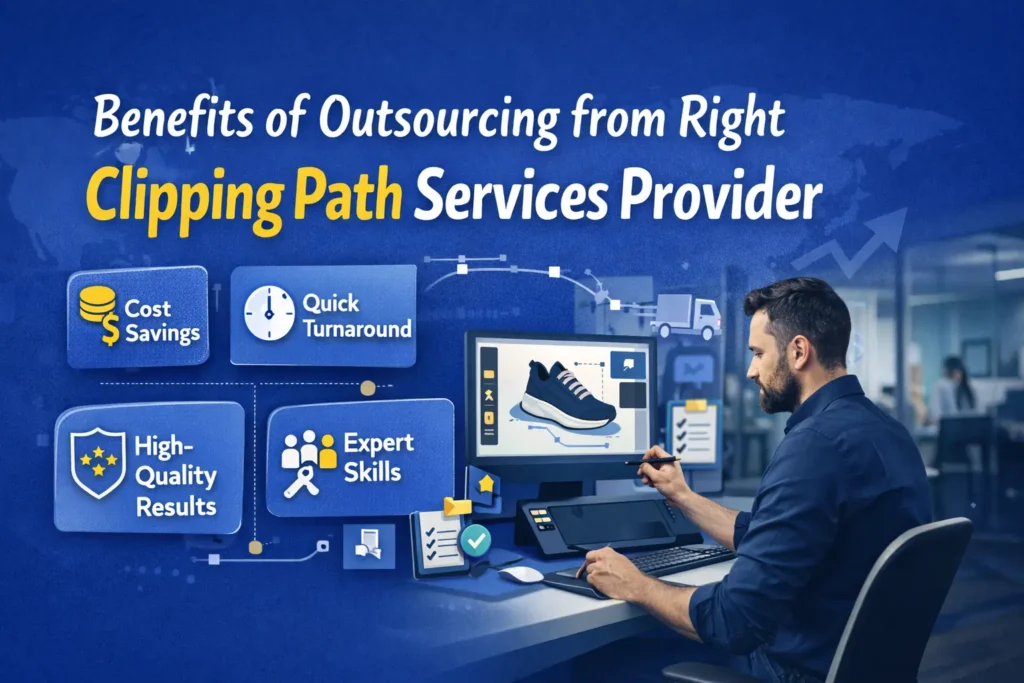
Benefits of Outsourcing from Right Clipping Path Services Provider
Cost Efficiency
Outsourcing eliminates the expense of hiring, training, and maintaining in-house editors. Businesses pay only for completed work, allowing predictable budgeting and avoiding long-term operational overhead and idle production costs.
Professional Image Quality
Clipping path experts deliver clean edges, accurate shapes, and consistent presentation. This improves product appearance, strengthens brand credibility, and meets strict marketplace image requirements without repeated fixes.
Time-Saving & Faster Turnaround
Dedicated production teams handle image processing continuously, reducing internal workload. Faster delivery allows products to go live sooner, supporting timely launches, seasonal campaigns, and rapid catalog updates.
Scalability for High-Volume Products
Outsourcing enables businesses to process hundreds or thousands of images through multi clipping path service support without slowing operations. Teams scale capacity up or down easily, supporting growth phases, promotions, and sudden inventory expansions.
Access to Skilled Experts & Advanced Tools
When you partner with a professional service, you aren’t just hiring labor, you are gaining access to a specialized team that uses industry-leading tools like Adobe Photoshop and Illustrator to handle your most complex visual challenges.
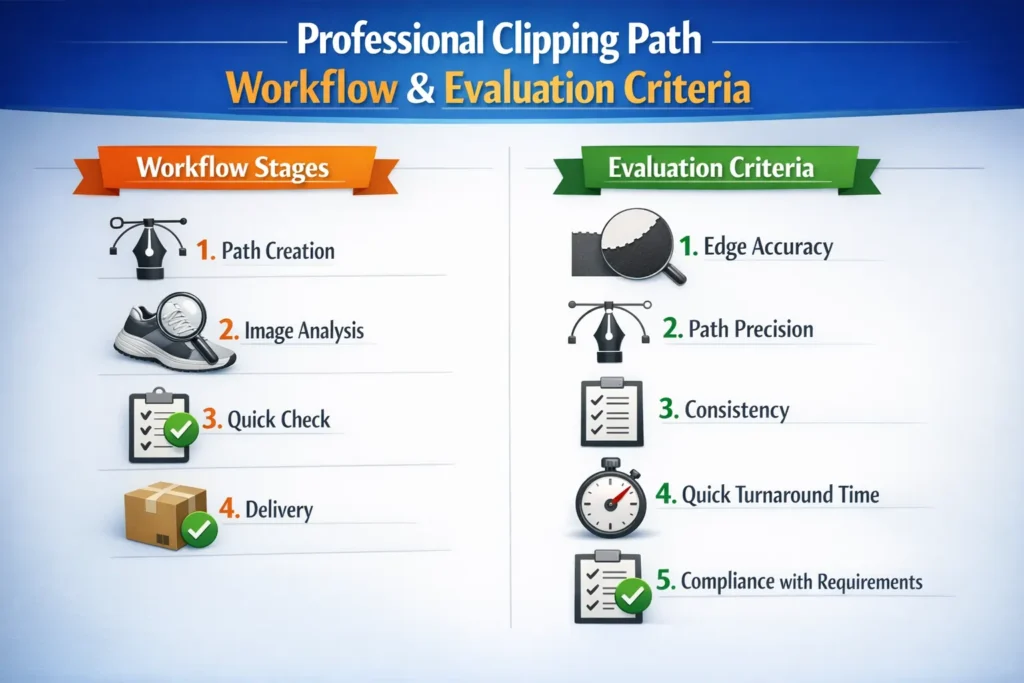
Professional Clipping Path Workflow & Evaluation Criteria
Workflow Stages
- Image Analysis: Image analysis involves reviewing photo edges and background complexity to determine the correct clipping approach before editing begins, ensuring efficiency and minimizing later fixes.
- Path Creation: Path creation is the stage where the image is carefully separated from the background, maintaining natural shapes without cutting or creating uneven edges.
- Quality Check: Quality check ensures the clipping path follows the image accurately, edges look smooth, colors remain unchanged, and files meet the required standards before final delivery.
- Final Delivery: Final delivery includes exporting files in the requested formats, verifying background requirements, and sending completed images securely within the given time.
Evaluation Criteria
- Edge Accuracy: Edge accuracy measures how clean and natural the cut looks, ensuring no rough outlines or visible background traces remain around the photo.
- Path Precision: Hand-drawn clipping path requires experience. Path precision evaluates how closely the clipping path follows the true shape of the picture without distortion, maintaining correct sizes and smooth curves.
- Consistency: Consistency checks whether all images in a batch follow the same clipping quality, edge style, and visual balance, especially important for large product catalogs.
- Quick Turnaround Time: Delivery time assesses how quickly images are completed without sacrificing quality, ensuring projects stay on schedule and product listings will be published on time.
- Compliance with Requirements: Compliance ensures the final images will meet client demands, including background style, file format, naming conventions, and platform-specific image guidelines.
Frequently Asked Questions
What industries benefit most from professional clipping path services?
E-commerce businesses, photographers, marketing agencies, designers, and online retailers benefit most because they require clean, consistent, and accurate images for catalogs, ads, branding, and marketplace compliance.
How do I evaluate clipping path quality before committing?
Evaluate edge accuracy, path precision, color consistency, file compatibility, and request a sample to confirm quality standards, attention to detail, and consistency before long-term engagement.
Are manual clipping paths better than automated solutions?
Manual clipping paths in Photoshop provide high-quality accuracy for complex edges and detailed shapes, while automated tools often fail with fine details, producing uneven cuts and inconsistent results.
How important is data security when outsourcing image editing?
Data security is critical because product images and business files are confidential. Secure systems, NDAs, and controlled access prevent misuse, leaks, or unauthorized distribution.
What turnaround time should professionals realistically expect?
Professional services typically deliver simple images within 24 hours, while complex or bulk projects depend on volume, ensuring speed without sacrificing quality or consistency.
Conclusion
Choosing the right clipping path service provider ensures accurate images, consistent quality, secure handling, and quick delivery.
By evaluating professional photo editing standards, workflows, communication, and long-term reliability, businesses can protect brand trust, meet platform requirements, reduce costs, and confidently scale visual production without compromising professionalism or operational efficiency.